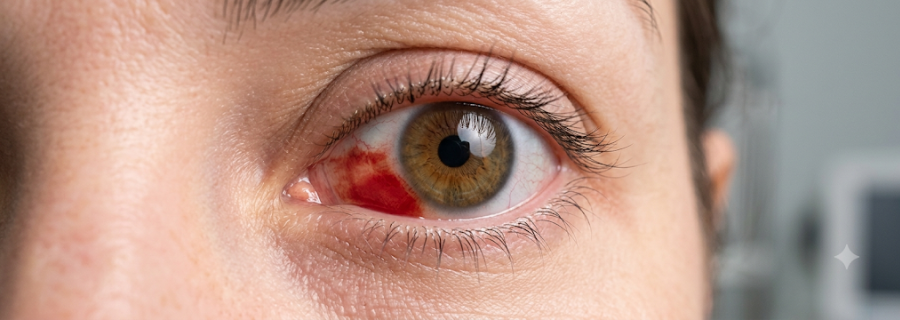
The terms “eye hemorrhage” or “bleeding in the eye” are commonly used to refer to a subconjunctival hemorrhage—a condition characterized by the appearance of a red blood spot within the eye.
This occurs due to the rupture of blood vessels located just beneath the conjunctiva, causing the blood spot to appear on the sclera (the white part of the eye). It is not a serious condition and typically does not affect vision, although some patients may experience uncomfortable symptoms.
An eye hemorrhage—or subconjunctival hemorrhage—can be caused by several factors:
An increase in eye pressure resulting from sudden physical exertion—such as coughing, sneezing, or vomiting—which can cause capillaries to rupture. It is important to note, however, that this is unrelated to intraocular pressure (eye pressure); it may, however, be related to blood pressure, which should be monitored.
- Anticoagulant medications (blood thinners) used for blood-related (hematological) conditions.
- Blows or trauma to the eye. Even rubbing the eyes vigorously can lead to minor bleeding within the eye.
- Issues related to high blood pressure (hypertension).
- Diabetes mellitus.
- Anemia.
- Malformations or abnormalities in the eye’s blood vessels.
Generally, a subconjunctival hemorrhage (an eye bleed) does not cause any symptoms, although it may lead to mild discomfort—such as the sensation of a foreign object in the eye or irritation—which can be relieved with artificial tears.
However, while it may look striking, it is not a serious condition; it is harmless. The blood we see does not leak out of the eye, as it is trapped within the **sclera** (the white part of the eye) and is reabsorbed shortly after it appears.
Currently, there are no standardized treatments to cure a subconjunctival hemorrhage (an eye bleed), as these resolve on their own over time.
The time it takes to disappear varies from person to person. If the subconjunctival hemorrhage is small, the blood will typically drain away on its own within about a week.
As the eye heals, the sclera (the white part of the eye) may turn yellow; this is completely normal. While the hemorrhage is clearing up, it is recommended that you **avoid rubbing your eyes, applying pressure, self-medicating, or placing any type of patch or gauze over the eye.**
While it is not possible to completely prevent eye hemorrhages, you can take steps in your daily life to help avoid them by following these guidelines:
- Check your blood pressure daily if you have hypertension or diabetes mellitus.
- Avoid sleeping on your left side. This position puts pressure on the heart and can increase blood pressure.
- Do not rub your eyes vigorously.
- Avoid the use of tobacco and the consumption of alcoholic beverages.
Remember to visit your
ophthalmologist if you experience an eye hemorrhage, in order to determine the underlying cause.