

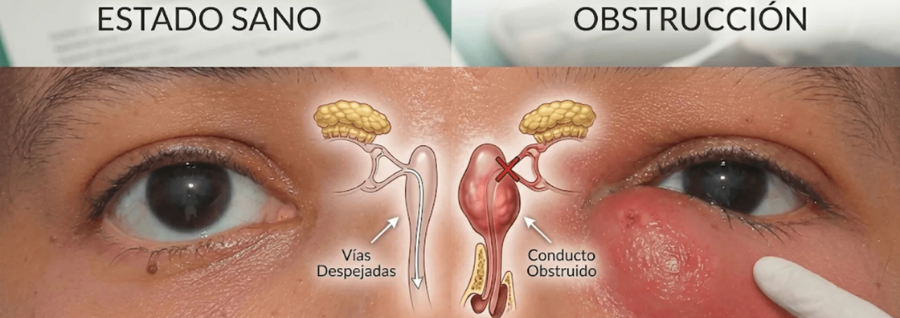
What is it?
It is a partial or complete blockage in the duct that carries tears from the surface of the eye to the nose.
Causes
Tears are constantly being produced to help protect the surface of the eye. They drain into a small opening (the punctum) in the corner of the eye, near the nose. This opening serves as the entrance to the nasolacrimal duct. If this duct becomes blocked, tears will accumulate and spill over onto the cheeks—even when you are not crying.
In children, this duct may not be fully developed at birth. It might be closed or covered by a thin membrane, resulting in a partial blockage. In adults, the duct can become damaged due to an infection, an injury, or a tumor.
Symptoms
- Increased tearing (epiphora), causing tears to spill over onto the face or cheeks. (In infants, this tearing becomes noticeable during the first two to three weeks after birth.)
- Thick tears that may dry and form a crust.
- In newborns, the presence of pus in the eyes or on the eyelids—in addition to a blocked tear duct—indicates an associated eye infection known as conjunctivitis, which occurs due to difficulty in draining tears and their subsequent pooling.
How do we treat it?
Treatments vary depending on the cause, the patient’s age, and the location of the obstruction (upper or lower). In adults, surgery is usually necessary to resolve the problem permanently.
For congenital cases (in newborns), an oculoplastic specialist—following an examination and diagnosis—will typically recommend performing massages on the lacrimal sac. If the obstruction persists after one year, the ophthalmologist will perform a probing procedure; antibiotic eye drops may also be used if an infection (dacryocystitis) is present.
For adults who have developed a lacrimal duct obstruction, treatment—determined by the attending ophthalmologist—can range from dilation, probing, and irrigation to surgery to create a new drainage pathway into the nose (dacryocystorhinostomy, or DCR). In some cases, intubation using tiny tubes (stents) may be performed to keep the duct open.