

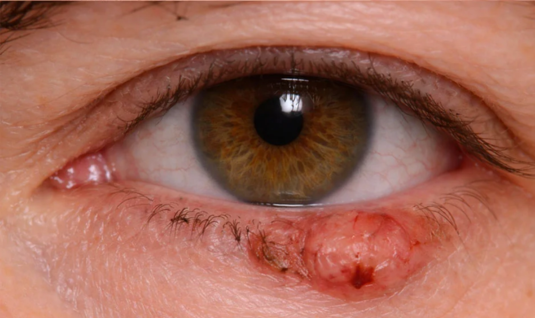
What are they?
Eyelid tumors are abnormal cell growths (masses or lumps) on the skin or glands of the eyelids, which may manifest as color changes, nodules, loss of eyelashes, or ulcers. Seeking an evaluation from an ophthalmologist specializing in oculoplastics for an early diagnosis allows for a very high cure rate in cases of malignant tumors.
These tumors can be benign—such as papillomas, keratoses, or moles—which grow slowly and do not invade surrounding tissues; or they can be malignant—such as basal cell carcinoma, squamous cell carcinoma, sebaceous carcinoma, or melanoma—which have the potential to invade local structures.
Causes and risk factors
Although they can appear without any prior history, the main factors are:
- Sun exposure: UV radiation is the primary cause of malignant tumors.
- Advanced age: More common in older individuals.
- Fair skin: Greater susceptibility to sun damage.
- Genetic/immunological factors: Hereditary predisposition or immunosuppression.
Symptoms
Although many tumors are asymptomatic, attention should be paid to:
- Lumps or nodules: The appearance of new, hardened (indurated), or wart-like lesions.
- Ulcers: Wounds that do not heal.
- Loss of eyelashes (madarosis): Especially in the area of the tumor.
- Pigmentation changes: Moles that grow or change color.
- Discomfort: Bleeding, itching, or the sensation of a foreign body.
How do we treat them?
A definitive diagnosis is made via biopsy, and surgical resection is the primary treatment. This may involve techniques such as Mohs surgery—a specialized, highly precise method for treating skin cancer (particularly basal cell and squamous cell carcinoma) in delicate areas like the eyelids and the periocular region. The procedure entails removing the tumor layer by layer, with each layer examined under a microscope in real time until the cancer is completely removed, while preserving as much healthy tissue as possible.
Once the tumor has been removed, an oculoplastic ophthalmologist will perform the reconstruction or repair of the eyelid. In some cases, it may be necessary to supplement the treatment with radiotherapy, cryotherapy, or topical chemotherapy.